What Does Epoxy Garage Floor Coating Cost in 2026?
7 min read · Last updated September 14, 2026
- Epoxy garage floor coating runs $7.78 to $12.71 per square foot professionally installed, per Homewyse’s May 2026 national cost data.
- A standard two-car garage (roughly 528 square feet) runs about $4,108 to $6,711 at that rate, before any crack repair or moisture remediation.
- Surface preparation to a concrete surface profile (CSP) of 3, achieved by light shot blasting or medium diamond grinding, is what most epoxy and polyaspartic systems actually require to bond, not the coating itself.
- A concrete slab with excess moisture can delaminate a coating from underneath; the F2170 test from ASTM International, a standards organization for building-material testing methods, measures relative humidity inside the slab before anyone applies a coat.
Epoxy garage floor coating costs $7.78 to $12.71 per square foot professionally installed, and that price swings less on the coating itself than on whether the concrete underneath got ground down first.
In this article
- What epoxy garage floor coating actually costs
- Surface preparation is the line item that determines whether it lasts
- Single-coat kits versus a professional multi-coat system
- The moisture test most quotes skip
- Your estimate may vary, and when hiring beats doing it yourself
- Frequently asked questions
Priya got two quotes to coat her two-car garage floor: $3,900 from a painter who planned to roll epoxy straight onto the existing slab, and $5,600 from a flooring contractor who priced grinding and a moisture test as their own line items. She took the cheaper bid. Eight months later, the coating was already lifting at the tire tracks, the exact failure the pricier quote’s prep work existed to prevent.
What epoxy garage floor coating actually costs
Homewyse’s May 2026 national cost data puts professionally installed epoxy garage floor coating at $7.78 to $12.71 per square foot, covering surface cleaning, crack repair, material, and labor. A standard two-car garage measuring 24 feet by 22 feet works out to 528 square feet: at $7.78 per square foot that’s $4,107.84, and at $12.71 per square foot that’s $6,710.88, so a real two-car garage runs roughly $4,108 to $6,711 before any structural crack repair or moisture mitigation gets added. A one-car garage around 240 square feet runs about $1,867 to $3,050; a three-car garage around 720 square feet runs about $5,602 to $9,151.
| Garage size | Approx. square feet | Typical total cost |
|---|---|---|
| One-car | 240 sq ft | $1,867 – $3,050 |
| Two-car | 528 sq ft | $4,108 – $6,711 |
| Three-car | 720 sq ft | $5,602 – $9,151 |
Surface preparation is the line item that determines whether it lasts
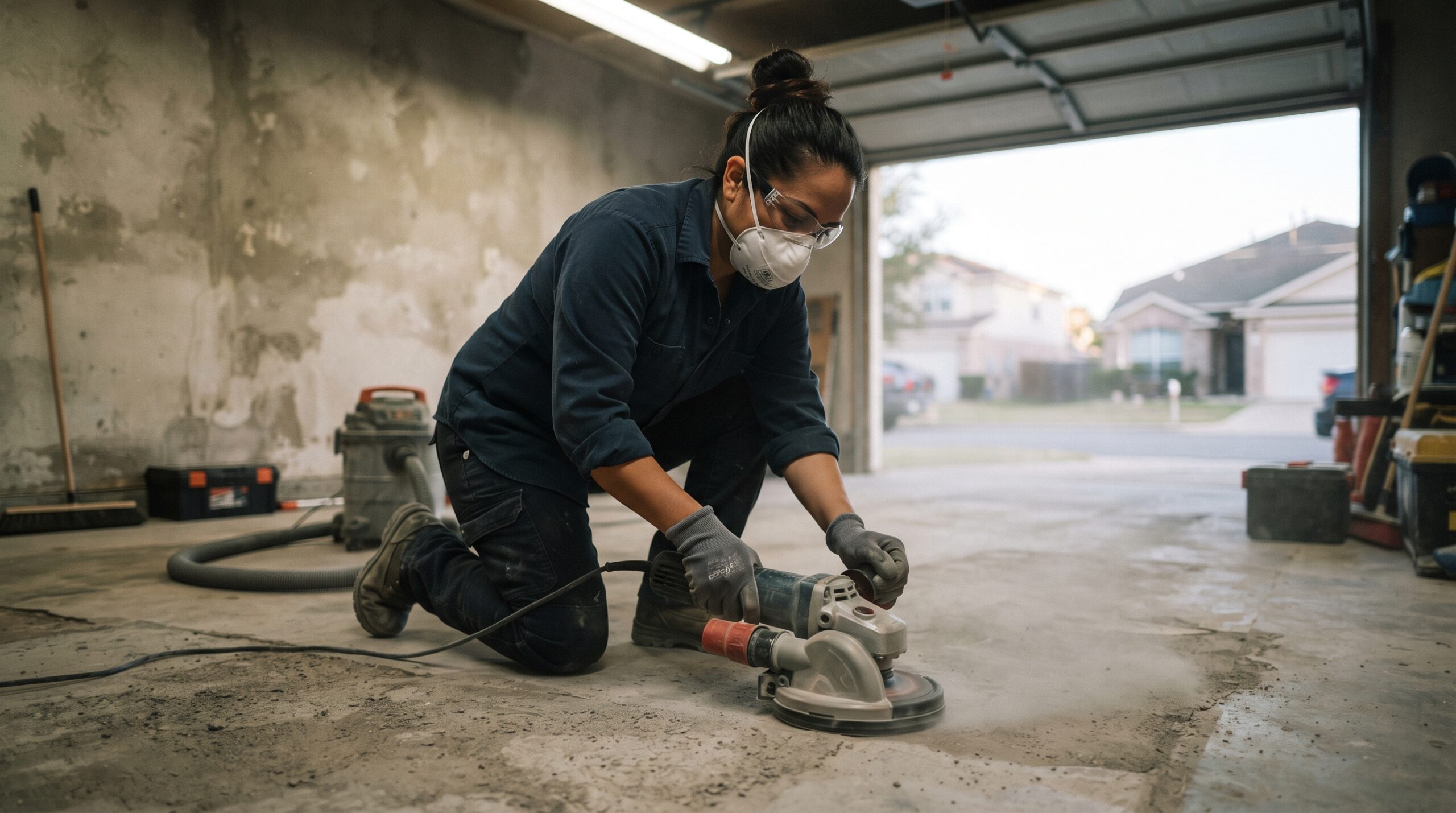
Epoxy and polyaspartic coatings bond to concrete by keying into a textured surface, described in the trade using a scale called concrete surface profile (CSP), running from CSP 1 (nearly smooth) to CSP 9 (heavily fractured). Most roll- and squeegee-applied epoxy and polyaspartic systems, the 10 to 20 mil range that covers a typical garage floor job, need a CSP 3 profile. Two methods get a slab there, per industry surface-prep guidance: diamond grinding, which lands in the CSP 1 to 3 range, or light shot blasting, which lands in CSP 3 to 5. For a look at how another flooring category prices out, see our hardwood floor installation cost guide. A crew that skips this step and coats over a smooth, unprepped slab is the single most common reason a garage epoxy job peels within the first year, regardless of how good the coating itself is.
Single-coat kits versus a professional multi-coat system
A single-coat do-it-yourself (DIY) kit from a home center goes down fast and costs less upfront, but it’s thinner, wears through faster under tire traffic and hot-tire pickup (the marks left when a warm tire sits on a coating), and typically needs recoating within a couple of years in a daily-use garage. The system this cost guide assumes, and what a professional quote should include, is a multi-coat build: a primer coat to seal the prepped concrete, a pigmented base or color coat, and a clear topcoat for abrasion and ultraviolet (UV) resistance. That third coat is what separates a floor that still looks new after five years of parking from one that’s visibly worn by year two.
The moisture test most quotes skip
Concrete slabs hold moisture long after they look and feel dry, and that trapped moisture can push up through a coating from underneath, causing bubbling, delamination, or a coating that never fully cures. ASTM International’s F2170 standard is the industry test method for checking, and independent testing-instrument guidance on how it’s performed fills in the specifics: a probe goes into a hole drilled to 40% of the slab’s depth if it can only dry from one side (the usual case for a garage slab on grade), or 20% if it can dry from both the top and bottom. The probe then sits for 24 hours to reach equilibrium before a reading counts, with a minimum of three probes for the first 1,000 square feet and one more for each additional 1,000 square feet. Coating manufacturers set their own relative-humidity ceiling for each specific product, so ask your contractor directly whether they ran this test and what threshold your chosen coating requires, rather than assuming a slab that looks dry is dry enough.
Your estimate may vary, and when hiring beats doing it yourself
Your actual price moves with a few real factors: an older slab with visible cracks needs repair before coating, which adds a line item; a slab with high ambient humidity or a history of water intrusion may need the moisture test and possibly a vapor-barrier primer; and labor rates for concrete-coating specialists run higher in some regions than in others. A single-coat kit applied by hand is a reasonable choice for a small, low-traffic space like a shed floor. A full garage floor that sees daily vehicle traffic, hot tires, and road salt in winter is not a good candidate for that approach: the grinding equipment alone is a rental most homeowners don’t own, and a coating applied over an improperly prepped or untested slab is money spent twice.
Get at least three quotes before you commit to a contractor, since a single bid gives you no way to judge whether the price or the scope is reasonable. Verify the contractor’s license and insurance before signing, and ask for a written estimate that itemizes grinding, moisture testing, primer, and topcoat as separate line items rather than one lump sum, the same discipline our guide to contractor quote red flags recommends for any home-service quote. And once the floor is done, our home maintenance cost breakdown shows where a coated garage floor fits into a full year of upkeep spending. If you have not collected quotes yet, our guide to hiring an epoxy flooring installer covers the moisture test and prep questions worth asking before any bid comes in.
Ready to compare local epoxy flooring quotes? Find a vetted epoxy flooring pro near you via Thumbtack and get free quotes from background-checked pros.
Frequently asked questions
How much does it cost to epoxy coat a two-car garage? Homewyse’s May 2026 data puts professional epoxy coating at $7.78 to $12.71 per square foot. A typical two-car garage at 528 square feet runs about $4,108 to $6,711, before any crack repair or moisture mitigation that an older or damp slab might need.
Why does surface prep matter more than the coating itself? Epoxy and polyaspartic coatings bond by keying into a textured concrete surface. Most systems need a CSP 3 profile, achieved by diamond grinding or light shot blasting. Skipping that step onto a smooth slab is the most common reason a garage epoxy job peels within its first year.
How do I know if my garage floor is too damp to coat? ASTM International’s F2170 test measures relative humidity inside the slab using a probe drilled to 40% of its depth. Each coating manufacturer sets its own moisture ceiling for that specific product, so ask your contractor whether they tested and what threshold applies.
Is a single-coat do-it-yourself (DIY) epoxy kit worth it for a garage? A single-coat kit works for light-use spaces but wears fast under daily vehicle traffic and hot tires. A professional multi-coat system, primer plus color coat plus a clear topcoat, holds up far longer in a garage that sees a car parked in it every day.
What’s the difference between epoxy and polyaspartic coatings? Both need the same CSP 3 surface prep. Polyaspartic systems cure faster, often within a day, and tolerate a wider temperature range during application, which is why some contractors price them at a premium over standard epoxy for the same job.