
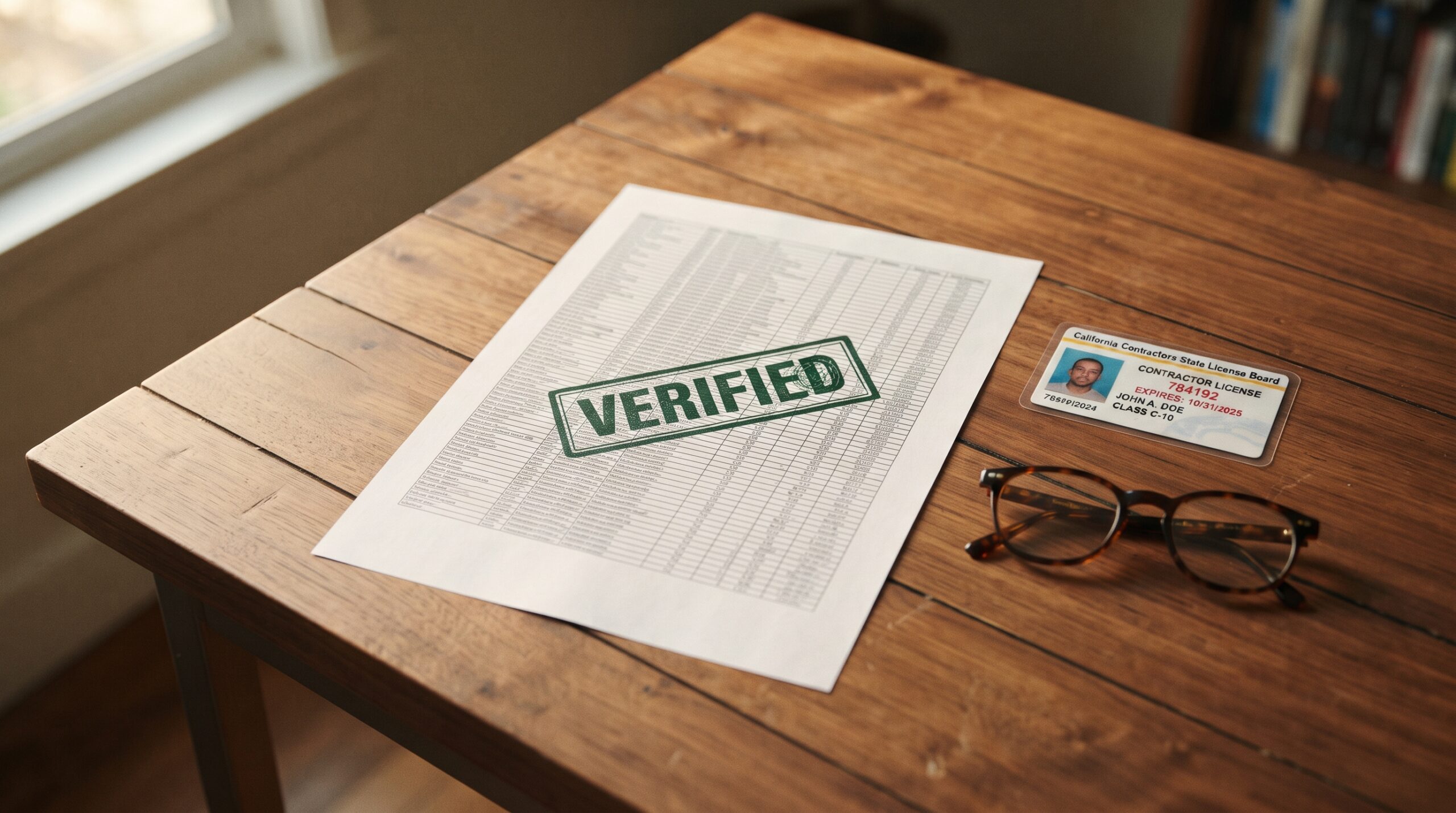
How to Verify a Contractor’s License in Under Ten Minutes, and What the License Does Not Cover
8 min read · Last updated August 3, 2026
- California requires a license for any project of $1,000 or more in combined labor and materials, a threshold raised from $500 on January 1, 2024, and every active license there carries a mandatory $25,000 surety bond.
- Colorado issues no state general contractor license at all. Roofers and remodelers are checked city by city or not at all, while electricians and plumbers still answer to a state board.
- A license lookup, not a truck door, is the only way to confirm bond and insurance status the day you hire, because both can lapse after the license was issued.
- When a contractor was never licensed to begin with, the board that would normally investigate often cannot force a refund. Small claims court becomes your only real path.
In this article
- What a license lookup actually confirms, and what it doesn’t
- Licensing rules change by state and by trade
- Five things to verify, and exactly where to check each one
- What happens when you skip this and hire someone unlicensed
- FAQ
Renee in Aurora, Colorado paid a $500 deposit to a roofer whose service truck read “Licensed, Bonded, Insured” in gold lettering across both doors. Nine days after the crew finished, a ridge cap blew off in a wind storm. She called Colorado’s Department of Regulatory Agencies to file a complaint and learned the state issues no general contractor license at all. Roofing sits outside state licensing entirely there. Only specific trades, like electrical and plumbing, carry a state credential in Colorado. The lettering on the truck was not a lie. It was also not a license.
What a license lookup actually confirms, and what it doesn’t
A state contractor license means the person passed a trade exam and a law and business exam, and proved enough experience to qualify. That is real screening, not the same as active coverage today. A license does not expire the moment an insurance policy lapses or a bond gets cancelled, and the board does not always catch it the same day. The Federal Trade Commission’s guide to avoiding a home improvement scam puts license verification first, but treats it as step one of several, the same sequence laid out in how to hire a contractor without getting burned. Ask for the license number before the walkthrough ends, then treat the bond, the liability coverage, and the workers’ comp as three separate questions.
Two other checks take just a few extra minutes and catch different problems than the license lookup does. A search of the Better Business Bureau’s business profile shows unresolved complaints and how a company responded to them, which a clean license does not reflect. Calling the local building department and asking whether this contractor’s name shows up on any recent permit pulls tells you whether the license is actually being used on real jobs in your area, not just kept active on paper. Neither check replaces the license and bond lookup. Both take less time than the walkthrough itself.
Licensing rules change by state and by trade
California runs one of the strictest systems in the country. Any project of $1,000 or more in combined labor and materials needs a licensed contractor, a threshold raised from $500 on January 1, 2024, and every active license carries a mandatory $25,000 surety bond, up from $15,000 the year before. Colorado runs the opposite system. Its own consumer guidance states plainly that general contractors and roofers are not licensed at the state level at all, checked city by city instead, while electricians and plumbers still answer to a state board. Same trade, wildly different paperwork. Check your state and trade before assuming either extreme applies to your job.
California also layers classifications on top of the license itself. A general building classification does not automatically cover electrical or plumbing subcontracting, since each of those carries its own specialty classification, so a single license number does not mean the holder is qualified for every trade on your project. The state’s lookup tool lists every classification tied to a license, and a contractor pitching a full remodel should be able to point to the classification that actually covers the scope you are hiring for, not just an active license number in general.
Five things to verify, and exactly where to check each one
| What to check | Where to check it | Why it matters |
|---|---|---|
| License status and classification | State licensing board lookup, such as the Contractors State License Board (CSLB) in California | Confirms the license is active, not suspended, and actually covers this trade |
| Surety bond status and carrier | Same license lookup tool on most state board sites | A lapsed bond means no payout if the contractor walks off the job |
| General liability insurance | A phone call to the carrier, not just the paper certificate | Certificates are a snapshot from the print date, not proof of coverage today |
| Workers’ compensation | State licensing board, or the insurer directly | Protects you from liability if an uninsured worker is hurt on your property |
| Local permit history | City or county building department | Shows whether this contractor’s past jobs actually passed inspection |
A license lookup on a state board’s own site, California’s runs through the CSLB, typically shows the first two in one search, plus the bond’s carrier and current status. Where a state doesn’t display insurance directly, call the carrier using the number on the carrier’s own site, not the contractor’s certificate, and ask if the policy is still in force. The National Association of Insurance Commissioners exists partly so you can confirm a carrier is real before trusting anything it issued. Ask to be named an additional certificate holder if the job runs more than a few weeks, so you get notified if the policy cancels mid-project.

When you call, have the certificate’s policy number and the contractor’s exact business name ready, and ask two direct questions: is this policy currently in force, and does it cover this type of work. A carrier that cannot confirm either one within a few minutes is itself a signal, since a real, active policy is quick for the issuing company to verify. If the certificate lists a policy that expired months ago, you have your answer before the contractor ever picks up a tool.
What happens when you skip this and hire someone unlicensed
If a contractor was never licensed at all, the board’s leverage over them disappears with it. California’s CSLB says directly that it has limited jurisdiction over unlicensed people and cannot force one to finish a job or repay you, even after investigating and referring the case for prosecution. Your path then is small claims court, a weaker hand than you would have held against a license the board could actually suspend. That is why the ten-minute lookup belongs before the deposit, not after the ridge cap blows off.
Filing with the state board is not the only option once you suspect a scam. The FTC’s ReportFraud.ftc.gov tool takes complaints against unlicensed and licensed contractors alike and feeds state and local enforcement, even when it cannot get your money back directly. Filing there and with your state board are not mutually exclusive, and a documented pattern of complaints against the same unlicensed operator is often what eventually gets a case referred for prosecution.
Get three written estimates from contractors whose license and bond you already verified, not three estimates followed by a background check on whichever is cheapest. Match the license classification to your scope. A painting license does not cover structural framing, and a licensed HVAC installer’s classification does not qualify them to reframe a wall either. The same logic applies to specialty niches within a single trade. A contractor licensed for asphalt shingle roofing is not automatically qualified, or even permitted, to install a metal standing-seam roof, since many states classify the two separately once you look past the general roofing category. The lowest of three verified bids is worth taking seriously once all three quote the same scope, the comparison red flags when reading contractor quotes walks through line by line. A verified license and a clean quote are still not the whole picture, so read what to ask before you sign the contract itself for the deposit cap, the change-order clause, and the lien-waiver checks that come next. License verification matters most on the trades where a mistake is dangerous, not just expensive: our guide to hiring an electrician walks through the same check specifically for panel and circuit work.
Ready to compare quotes from contractors you can verify before you sign? Find a vetted contractor near you via Thumbtack and get free quotes from background-checked pros.
Frequently asked questions
How do I actually look up a contractor’s license? Search your state’s licensing board. Most run a free public lookup by license number or business name and show status, classification, and bond together, usually in under two minutes. If your state has no general contractor license, check whether the specific trade is licensed separately, since electrical and plumbing often are even where general contracting is not.
Does every state license general contractors the same way? No. California requires a license above $1,000 in combined labor and materials and backs every license with a $25,000 bond. Colorado issues no state general contractor license at all and regulates it city by city instead, though it still licenses electricians and plumbers at the state level. Confirm your state and trade before assuming either pattern applies to your job.
What is a contractor bond, and how much protection does it provide? A bond is money the bonding company pays out, up to its limit, if the contractor violates licensing law and a claim is filed and proven against them. It is not insurance for job-site accidents or shoddy work generally, and a bond that has already lapsed or been exhausted by a prior claim pays nothing on yours.
Can a state licensing board get my money back if I hired someone unlicensed? Often not directly. Boards can investigate an unlicensed contractor and refer the case for prosecution, but most cannot force that person to pay you restitution as part of the process. Small claims court is the more reliable path to recovering money from someone who was never inside the licensing system to begin with.
Does a valid license mean the contractor’s insurance is current today? Not automatically. A license and an insurance policy are tracked by two different systems, and coverage can lapse months after the license was issued without the board necessarily catching it right away. Call the carrier directly, using the number on the carrier’s own site, to confirm the certificate you were handed still reflects an active policy today.