A Contractor’s Certificate of Insurance: What It Proves, and What You Still Have to Check
8 min read · Last updated October 19, 2026
- A certificate of insurance (COI) states in its own printed language that it “confers no rights on the certificate holder” and is informational only, true of the standard form nearly every insurer uses.
- Insurers have had no standing obligation to notify a certificate holder before a policy cancels since the standard certificate form dropped that notice language in 2009; the policy itself, not the certificate, controls who gets told.
- No federal law sets a minimum general liability amount for contractors; the number on a certificate only means something next to what your contract or state licensing board actually requires.
- Asking a contractor’s insurer to add you as an “additional insured” costs you nothing to request; when the insurer does charge for it, that fee commonly runs $25 to $100 and it is the contractor’s cost, not yours.
A contractor’s certificate of insurance confirms only that a policy existed on the day the certificate was printed. The one way to know whether that policy is still active is to call the carrier or agent listed on the certificate directly, because nothing obligates them to call you first if it lapses.
In this article
- What a Contractor’s Certificate of Insurance Actually Shows
- How to Verify the Policy Directly With the Carrier
- The Additional Insured Endorsement, and Why Asking Costs You Nothing
- What to Do If the Contractor Won’t Cooperate
- Frequently asked questions
Say a homeowner named Renata Holt, in Tulsa, Oklahoma, collected a certificate of insurance from a roofer two weeks before signing a $14,000 reroof contract. She filed it away, assuming the paperwork alone meant she was covered if a crew member fell off her roof. The certificate was real, but it only proved something was true on the day it was printed.
What a Contractor’s Certificate of Insurance Actually Shows
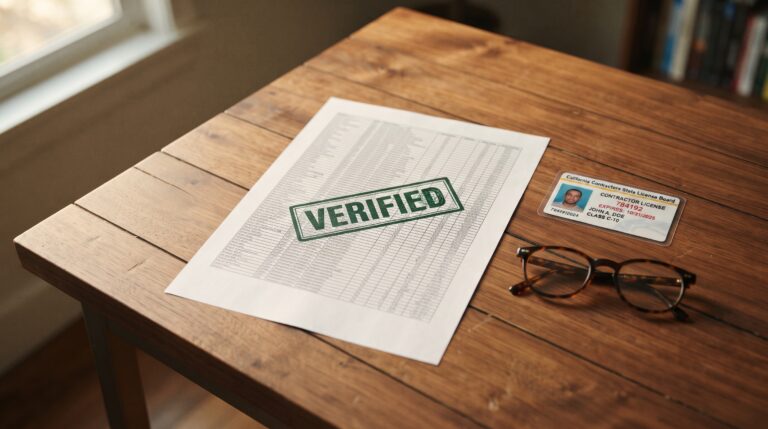
Most certificates use the same form, the ACORD 25 (ACORD is the Association for Cooperative Operations Research and Development, the insurance-industry group that designs standardized forms like this one). It lists the insurer, the policy number, the coverage limits, the effective dates, and whoever is named as the certificate holder.
That form also carries its own built-in warning. Risk Management magazine, published by RIMS (the Risk and Insurance Management Society), quotes the standard wording directly: “This certificate is issued as a matter of information only and confers no rights on the certificate holder.” The same article notes that certificates “are only valid at the exact moment in time they are issued.”
A certificate’s declared limits tell you what the contractor applied for, nothing more. No federal law sets a minimum general liability amount for contractors, so those numbers only mean something once you compare them against what your contract or state licensing board actually requires. A certificate showing high limits does not tell you the premium was paid last month, or that the policy survived a midyear audit.
How to Verify the Policy Directly With the Carrier
Get at least three quotes before you pick a contractor, and treat the certificate request as a normal part of that process, not a special favor. Every contractor you are seriously considering should hand one over without pushback.
Then call. The agent or insurer’s phone number sits right on the certificate. Ask three things: is this policy currently in force, through what date, and do the limits shown match what you were told. GEICO’s own consumer guidance puts it plainly: a certificate “only reflects coverage at the time it was issued,” and policies “can lapse, cancel, or change after the certificate is created.”
This step matters because of a change most homeowners have never heard of. In 2009, the standard certificate form removed language where the insurer agreed to notify the certificate holder before a policy cancelled, according to construction trade publication Engineering News-Record (ENR). The policy itself controls that notice now, and it almost never grants that right to a homeowner, so a contractor’s policy can lapse mid-project without you hearing about it unless you call.
Ask for a written, line-item estimate at the same time you ask for the certificate. A contractor who hands over clean paperwork on both counts, without stalling, is telling you something about how the rest of the job will go.
The Additional Insured Endorsement, and Why Asking Costs You Nothing
A certificate lists you as the certificate holder, which is different from being named an “additional insured” on the actual policy. A certificate holder just receives paperwork. An additional insured has a direct right to file a claim against the contractor’s policy for damage their work causes to your property.
Ask the contractor to request this endorsement from their insurer before work starts. Fortune’s reporting on additional-insured coverage found it is sometimes added free of charge, and when an insurer does bill for it, the typical range runs $25 to $100. That cost, when it exists at all, belongs to the contractor’s policy, not your wallet, and the ask itself never costs you anything.
Match the contractor’s experience to the scope of your project before you get this far. A contractor who has handled five jobs like yours and carries the matching coverage is a safer bet than one who is cheaper but unfamiliar with the work, and the lowest bid is not automatically the one that protects you best once something goes sideways.
What to Do If the Contractor Won’t Cooperate

A contractor who readily asks their agent for the additional-insured endorsement and a current certificate is showing you a working relationship with their own insurer. That is a good sign on its own. Renata called the number on her roofer’s certificate, and the agent confirmed the policy was active in under two minutes, which is the outcome this whole exercise is built to find.
A contractor who refuses to even ask, or who cannot produce a certificate at all, has told you something too. Walk away before you sign, not after a problem shows up on your property.
If you confirm by phone that a policy has lapsed, do not accept a promise that it will be renewed “before the job starts.” Ask for the new certificate and verify that one the same way, since a gap in coverage during active work is the exact scenario a two-month-old certificate cannot catch.
| Document or step | What it proves | What it costs you |
|---|---|---|
| Certificate of insurance | A policy existed, at the limits shown, on the day the certificate was printed | Free; the contractor’s agent prints it on request |
| Additional insured endorsement | You have a direct right to file a claim on the contractor’s policy for damage their work causes to your property | Free to ask for; if the insurer bills for it, that fee is the contractor’s, commonly $25 to $100 |
| Direct carrier verification | Whether the policy is active right now and through what date, not just on the day the certificate was printed | Free; a phone call to the number on the certificate |
Before you sign anything, run the license check alongside this insurance check, and read back through any quote for the red flags that show up before a contract is signed. Insurance, licensing, and a clean quote are three separate checks, and skipping one does not get covered by doing the other two well.
Ready to compare quotes from contractors whose coverage you can actually confirm? Find a vetted contractor near you via Thumbtack and get free quotes from background-checked pros, the screening step a certificate alone cannot replace.
Frequently asked questions
What is a certificate of insurance?
A certificate of insurance (COI) is a one-page summary, usually the standard ACORD 25 form, showing a policy’s insurer, limits, and effective dates. It is not the policy itself, and its own printed language states it confers no rights on whoever is holding it. Treat it as a starting point, not a final answer.
How do I verify a contractor’s insurance is actually active?
Call the phone number for the agent or insurer printed on the certificate and ask directly whether the policy is currently in force, through what date, and whether the limits match what you were told. Insurers are not required to notify you if a policy cancels, so a certificate from even a few weeks ago can already be outdated.
What does “additional insured” mean, and should I ask for it?
Being named an additional insured gives you a direct right to file a claim against the contractor’s policy if their work damages your property, instead of just holding paperwork. Ask the contractor to request this from their insurer before work begins. The request costs you nothing, even if the contractor’s insurer bills a modest fee for adding it.
How much general liability insurance should a contractor carry?
There is no single national minimum. The right amount depends on your state’s licensing rules and the scope of your project, and a larger remodel or a job with higher exposure calls for more coverage than a small repair does. Confirm the actual limits on the certificate match both what the contractor told you and what your contract specifies before signing.
What happens if a contractor’s insurance lapses in the middle of my project?
If the policy cancels mid-project and you were never notified, you could be left without coverage for an incident that happens during that gap. If you learn a policy has lapsed, stop work until you see and verify a current replacement certificate rather than accepting a verbal promise that coverage is being renewed.