Hire a Flooring Installer Near You
6 min read · Last updated June 4, 2026
In this article
- Before You Call: What to Prepare
- Questions to Ask Every Flooring Installer
- Red Flags During the Quote
- How to Read a Flooring Estimate
- FAQ
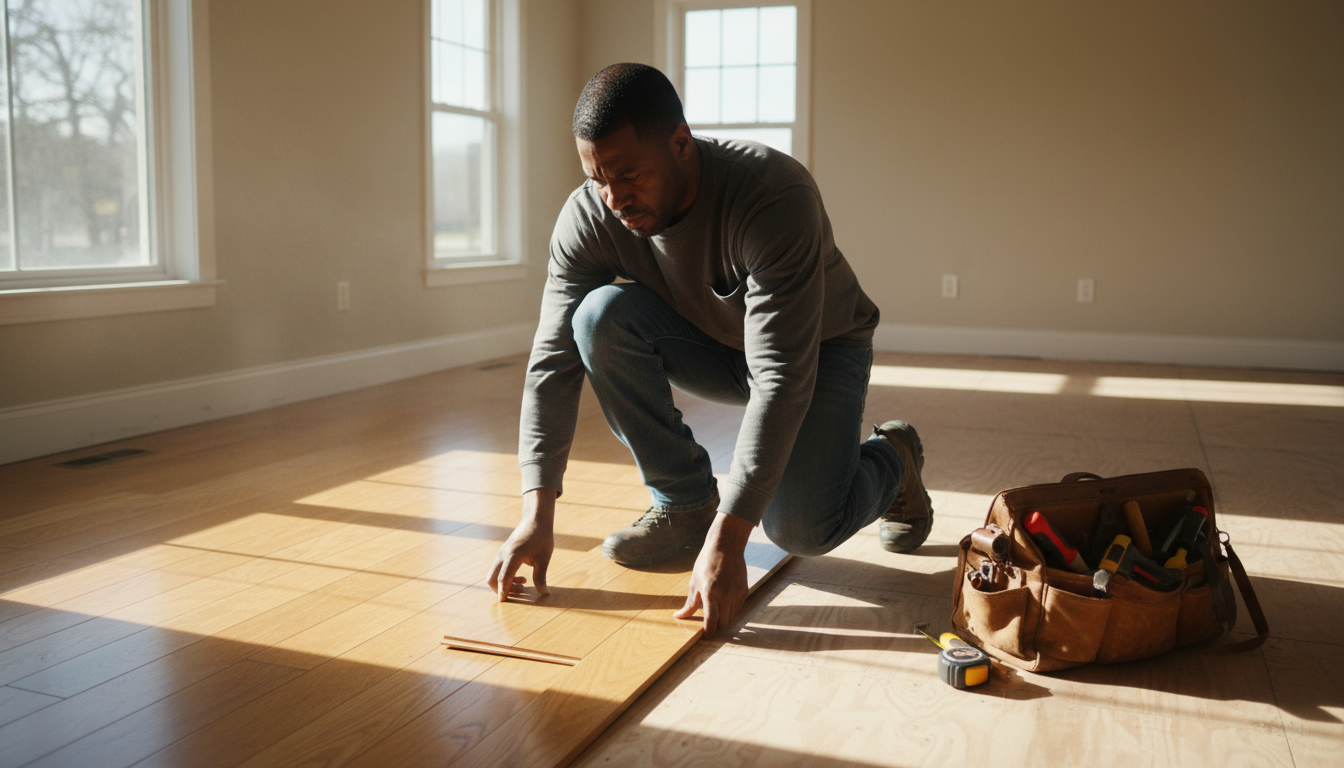
Marcus called three flooring installers for quotes on the 900-square-foot living room and dining area he wanted converted from carpet to engineered hardwood. The numbers came back at $4,200, $5,800, and $7,100. He accepted the low bid. Six months later he spent another $1,400 when gaps appeared along the baseboards because the installer skipped moisture testing the subfloor.
Before You Call: What to Prepare
Measure the square footage yourself before you contact anyone. Multiply length by width, add 10 percent for waste, and write it down. Installers will measure too, but starting with your own number lets you flag suspicious overestimates.
Know your subfloor type. Concrete slab, wood plywood, or OSB each affect installation cost. Installers working with concrete slab charge more for moisture barriers. Installers working over old adhesive-backed vinyl add a demo fee. These are legitimate costs, but they should appear as named line items on the estimate, not as surprises on the invoice.
Prepare photos before the appointment. Photos of every room, the current flooring condition, the baseboards, and any spots where the subfloor feels soft or uneven let pros study the job before they arrive. It separates the installers who price carefully from the ones who quote from memory.
Always get a written estimate with line-item detail and verify license and insurance before signing. Most states do not license flooring installers at the specialty level, but every contractor in your home should carry general liability insurance and workers’ compensation coverage. Ask for a certificate of insurance listing your address on the job dates.
Questions to Ask Every Flooring Installer
What does subfloor prep include in your quote? This is the most important question on the list. Subfloor prep is where low-bid installers cut corners. A complete prep includes checking for moisture, leveling low spots, tightening squeaky boards, and removing old adhesive. Ask the installer to confirm these steps in writing. A quote that says “installation” without specifying prep is a quote worth pushing back on.
Who will be doing the work – your employees or subcontractors? Neither is disqualifying, but you should know who carries liability for the work. In-house crews usually mean more accountability when something goes wrong.
How do you handle transitions, baseboards, and thresholds? Transitions between flooring types and quarter-round at baseboards are where a cheap installation shows its age first. Confirm whether baseboard removal and reinstall is included in the price, or whether the installer uses new quarter-round to cover the expansion gap.
What is your warranty policy? A reputable installer should offer at least a one-year workmanship warranty. If the installer says no warranties, that signal is worth taking seriously.
Red Flags During the Quote
An installer who quotes from the doorway without measuring is estimating by eye. Eye estimates run 10 to 20 percent off, and those errors become your problem on the final invoice. Any installer worth hiring measures every room before quoting.
Watch for quotes that do not include waste material. A professional installer accounts for 8 to 12 percent waste in the materials estimate. A quote calculated at exactly your measured square footage either cut the waste factor or is planning to add it as a surprise line item later.
Be cautious of anyone asking for more than 25 to 30 percent upfront. Large deposits before work starts are a consistent red flag in home contracting. A reasonable deposit covers material ordering and nothing more.
How to Read a Flooring Estimate
Match the square footage on the estimate to your own measurement. A discrepancy of more than 5 percent is worth asking about directly.
Look for what is not listed. If the estimate does not mention subfloor prep, ask what happens if prep is needed. Get the per-square-foot upcharge rate in writing before work starts, not after demo reveals a moisture problem.
Verify material specs match what was discussed. An estimate that says “engineered hardwood, 3-inch plank” is less specific than a named product with stated thickness and wear layer. If the installer quoted a specific product in conversation, that product name should appear on the estimate.
Check the payment schedule. Progress payments tied to completion milestones are standard. Full payment due before work starts is not.
Ready to compare local flooring installer quotes? Find a vetted flooring installer near you via Thumbtack and get free quotes from background-checked pros.
FAQ
How much does it cost to hire a flooring installer? Most homeowners pay between $3 and $14 per square foot for floor installation, depending on the material. Laminate and vinyl plank installation runs $3 to $8 per square foot including materials. Solid hardwood runs $8 to $14 per square foot. On a 1,000-square-foot job, that range spans roughly $3,000 to $14,000 before subfloor prep and demo – see our floor installation cost guide for the full breakdown by material type.
Do I need to hire a licensed flooring contractor? Most states do not require specialty licenses for flooring installation the way they do for electrical or plumbing. The installer should still carry general liability insurance and workers’ compensation coverage. Ask for a certificate of insurance before work begins. If the job involves subfloor repairs or structural work, a contractor’s license may be required depending on your state.
How many quotes should I get before hiring a flooring installer? Get at least three. Three quotes give you a realistic price band and make outliers visible in both directions. A quote that comes in 30 percent below the other two is telling you something about scope, speed, or materials.
What should I do to prepare before the flooring installer arrives? Clear all furniture from the rooms being done before the start date. For hardwood and engineered wood installs, most manufacturers recommend acclimating the flooring material in the room for 48 to 72 hours before installation. Ask your installer whether they handle this or whether you need to arrange delivery in advance.
What is the difference between engineered hardwood and solid hardwood installation? Solid hardwood is nailed or stapled to a wood subfloor and cannot be installed over concrete. Engineered hardwood can be floated, glued, or nailed and works over both wood and concrete subfloors. Verify that the installer you hire has specific experience with your material type before signing.