
What Does It Cost to Replace a Water Heater in 2026?
7 min read · Last updated August 24, 2026
- A standard 40 to 50 gallon gas tank installs for $800 to $2,500; the same size electric tank runs $700 to $2,000, all-in with labor and code-required parts.
- A tankless conversion runs $1,200 to $2,800 for a direct swap with compatible venting, or $2,500 to $7,000 or more when a new gas line, venting, or electrical panel is required.
- Producer prices for plumbing fixtures and fittings rose 4.9% year over year through July 2026, according to the Bureau of Labor Statistics, which is showing up in equipment quotes this year.
- Permits run $50 to $300 and haul-away of the old unit runs $25 to $100. If a quote shows neither line item, ask why.
In this article
- What a water heater installation actually costs by type
- What moves the price up or down
- Reading two quotes for the same job
- Hire a pro or handle it yourself
- Frequently asked questions
David, outside Columbus, got two quotes to replace a failing 50-gallon gas tank with a tankless unit, both from licensed installers, both quoting the same equipment brand. Quote A came in at $5,700. Quote B came in at $6,800. Same house, same job, an $1,100 gap. Here is what an installed water heater actually costs in 2026, and where a spread like that one comes from.
What a water heater installation actually costs by type
Installed pricing for standard tank replacements lines up with what installers in most metro markets are quoting this year once labor and code-required parts are included rather than just the equipment. Tankless pricing below draws on a separate breakdown, since a conversion carries its own venting and gas-line variables that a simple tank swap does not.
| Scope | Typical installed range | Notes |
|---|---|---|
| Gas tank, 40-50 gal, direct swap | $800 – $2,500 | Same-day in most cases |
| Electric tank, 40-50 gal, direct swap | $700 – $2,000 | No venting to replace |
| Heat pump / hybrid tank | $2,000 – $4,000 | Needs roughly 700+ cubic feet of surrounding air space |
| Tankless, direct swap | $1,200 – $2,800 | Requires compatible venting and adequate gas line already in place |
| Tankless, full conversion | $2,500 – $7,000+ | New gas line, new venting, or electrical panel work |
Producer prices for plumbing fixtures and fittings rose 4.9% year over year through July 2026, per the Bureau of Labor Statistics (BLS), the federal agency that tracks wholesale price trends. That increase is landing in equipment costs on top of normal labor pricing, so a quote that looks higher than a range you saw last year is not automatically padded.
What moves the price up or down
| Factor | Impact on price |
|---|---|
| Switching fuel type (electric to gas or gas to electric) | Adds $500 to $1,500 or more for a new gas line or dedicated electrical circuit |
| Equipment tier (standard vs. heat pump or condensing tankless) | $1,000 to $2,000 more than a standard tank |
| Access difficulty (attic, tight closet, multi-story run) | Adds labor hours, commonly $200 to $600 |
| Code-required parts missing from the old setup (expansion tank, drain pan, updated venting) | $300 to $1,500 combined, depending on what was missing before |
| Permit and inspection | $50 to $300, required in most jurisdictions |
Your own number will move against this table based on your fuel type, your home’s layout, and your local permit fees. A 50-gallon gas tank in a single-story home with an accessible closet lands at the low end of its range; the same unit at the top of a narrow attic stairway does not, since every extra flight of stairs and every tight turn adds labor time the installer has to price in. A larger household with two bathrooms and a washing machine running at the same time as a shower also needs a higher-capacity unit than a single-occupant condo, which shifts the whole quote up a tier regardless of fuel type.
Reading two quotes for the same job
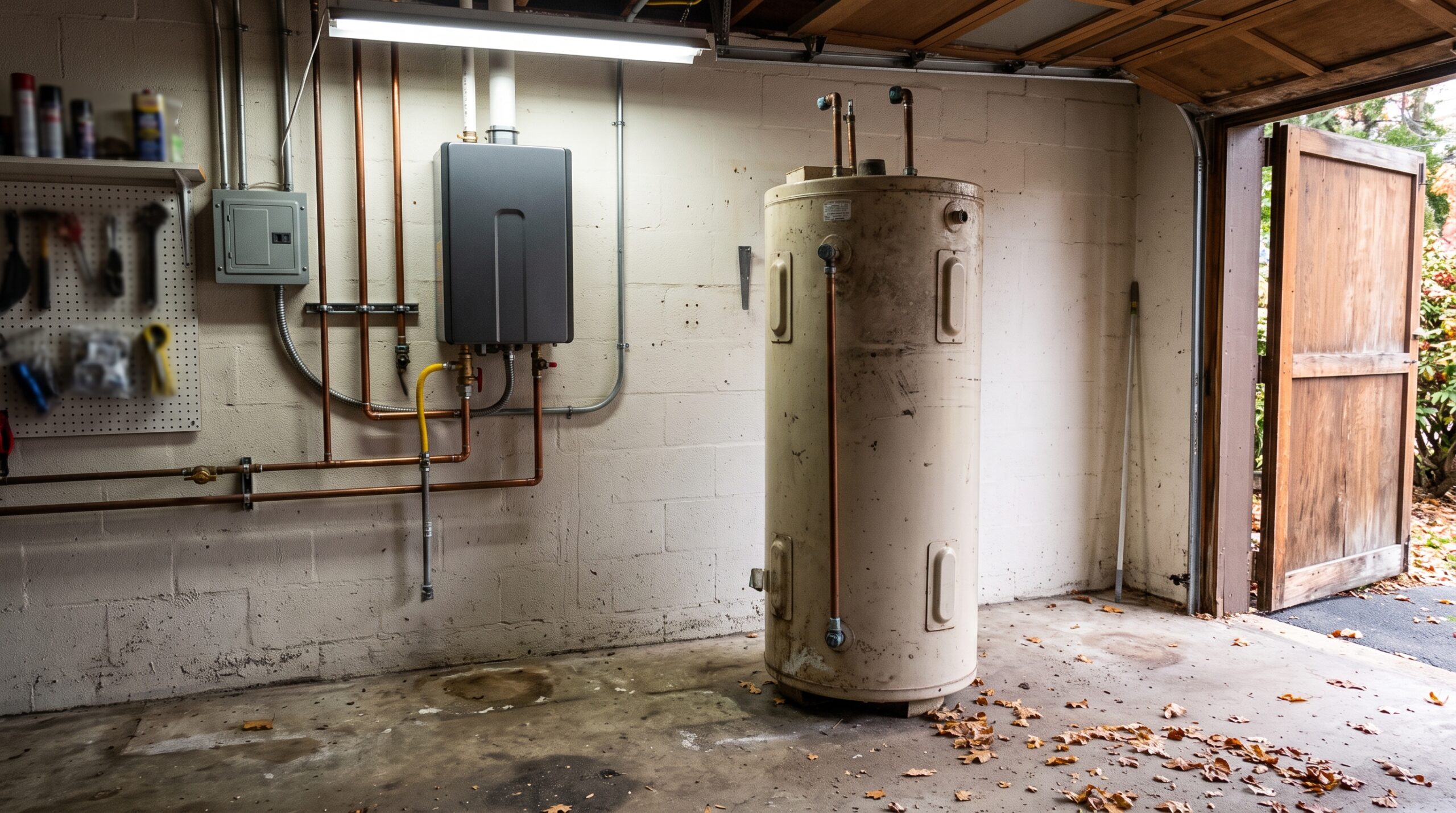
Here is how David’s two quotes actually broke down. Quote A: unit $1,800, labor $2,200, gas line upgrade $900, venting $500, permit $150, haul-away $150. That totals $5,700. Quote B, same equipment brand: unit $1,800, labor $2,600, gas line upgrade $1,400 because that installer found the existing half-inch line needed upsizing to three-quarter inch across a longer run, venting $650, permit $200, haul-away $150. That totals $6,800.
Most of that $1,100 spread, $650 of it, is in the gas line and venting lines, not the equipment. The rest is $400 in labor and $50 in the permit fee, both of which track with the larger scope Quote B’s installer actually priced. Quote B’s installer measured the existing gas line before quoting; Quote A’s installer priced the conversion as if the line was already adequate, which usually means that cost shows up later as a change order once the job is underway.
Get at least three quotes before you commit to an installer, verify each one’s license and insurance, and match each line item side by side rather than comparing bottom-line numbers. A quote missing the permit line, the haul-away fee, or a specific gas line assessment is not necessarily cheaper. It is often incomplete, and the lowest bid is not automatically the best choice once you see what it left out. Contractor quote red flags covers the broader pattern of what an incomplete quote tends to hide, and it applies here the same way it applies to any trade.
Hire a pro or handle it yourself
A water heater installation touches gas or high-voltage electrical lines, pressurized water, and combustion venting, so this is not a weekend DIY project the way a leaky faucet washer is. Minor maintenance, like flushing sediment out of a tank annually or replacing an anode rod, is reasonable for a comfortable homeowner, and doing it on schedule is one of the few things you control that actually extends the unit’s working life. A full unit swap or fuel-type conversion is licensed-trade work, both because the code items matter for safety and because what to ask before you sign a contractor’s contract protects you if something goes wrong during a job like this one. If you are budgeting for this alongside other systems in the house, average home maintenance cost per year shows where a water heater replacement typically lands against everything else that comes up.
Water heater work is one line item in a bigger plumbing picture. Plumbing Repair Cost breaks down what drain clearing, leak repair, and fixture replacement run when the job is elsewhere in the house.
Frequently asked questions
Why did my two water heater quotes come in so far apart for the same unit? The equipment is usually priced close to identically across licensed installers. The spread almost always comes from labor hours, gas line work, venting work, and whether code-required parts like an expansion tank were already accounted for. Ask each installer to itemize those four lines before comparing totals.
Is a heat pump water heater worth the higher installed cost? It depends on your electricity rates and whether you have the roughly 700 cubic feet of surrounding air space the unit needs to draw heat from. The installed cost runs $2,000 to $4,000 against $700 to $2,000 for a standard electric tank, and the payback period depends on local utility rates more than the equipment itself.
What should be included in a water heater installation quote? A complete quote itemizes the unit and capacity, labor, any code-required parts like an expansion tank or updated venting, the permit fee, and haul-away of the old unit. If a quote is a single bottom-line number with no breakdown, ask the installer to itemize it before you compare it to anything else.
How much should I budget for haul-away of the old unit? Haul-away and disposal of the old water heater typically runs $25 to $100 as a separate line item. Some installers fold it into the labor charge instead of listing it separately, which is fine as long as you confirm removal is included somewhere in the total.
Ready to compare local water heater installation quotes? Find a vetted water heater installer near you via Thumbtack and get free quotes from background-checked pros.