Hire a Gutter Installer Near You
*5 min read · Last updated June 04, 2026*
In this article
– What to prepare before contacting a gutter installer – Questions to ask before signing – Red flags during the quote process – Understanding the cost range – FAQ
Marcus called three gutter companies after a heavy April storm left water pooling along his foundation. The estimates came back at $640, $1,140, and $1,520 for replacing 160 linear feet of aluminum gutters on his Cape Cod in Columbus. Same scope, same material, $880 spread. The difference: the lowest bid was sectional gutter with a one-year labor warranty, the middle was seamless aluminum with a five-year warranty, and the highest included gutter guards. Understanding those differences before he signed saved Marcus from picking the cheapest option and regretting it inside two winters.
What to prepare before contacting a gutter installer
Spend 20 minutes before you make a single call. Walk the perimeter and estimate total linear footage – gutters run along every eave. Note the number of corners, your existing downspout locations, and any complex roofline sections (dormers, attached garage, covered porch). Photograph anything you are not sure about.
While you are outside, check your fascia boards. Gutter installers attach directly to the fascia, and rotted wood needs replacing before gutters go up. Many contractors include fascia repair as an add-on line item; knowing the condition in advance tells you whether that line is legitimate or padding.
Note if your home is two stories or has a steep pitch. Ladder access adds labor time and sometimes requires a lift, and not every quote accounts for it. Before calling, also look up your state’s contractor licensing requirements – most require either a general contractor license or a home improvement registration.
Questions to ask before signing
Ask every contractor the same questions and compare answers, not just price.
Are you licensed and insured in this state? Ask for the license number and verify it on your state contractor board’s website. Liability insurance should be at minimum $300,000; request a certificate naming you as certificate holder. Confirm workers’ compensation exists if the crew has employees.
Seamless or sectional? Seamless gutters are formed on-site from a continuous roll with no joints except at corners – every sectional connector is a future leak point. Seamless costs $1 to $2 more per linear foot and outlasts sectional by a decade. Ask which you are getting.
What gauge aluminum? Standard is .027-inch; heavy-gauge is .032-inch and resists denting from ladders. The upgrade costs $0.50 to $1.00 more per linear foot and is worth asking about.
What does the warranty cover? A legitimate warranty covers materials and labor. Labor-only warranty means a slope problem or loose spike costs you extra to fix. Five years on labor is standard; less than two years is worth questioning.
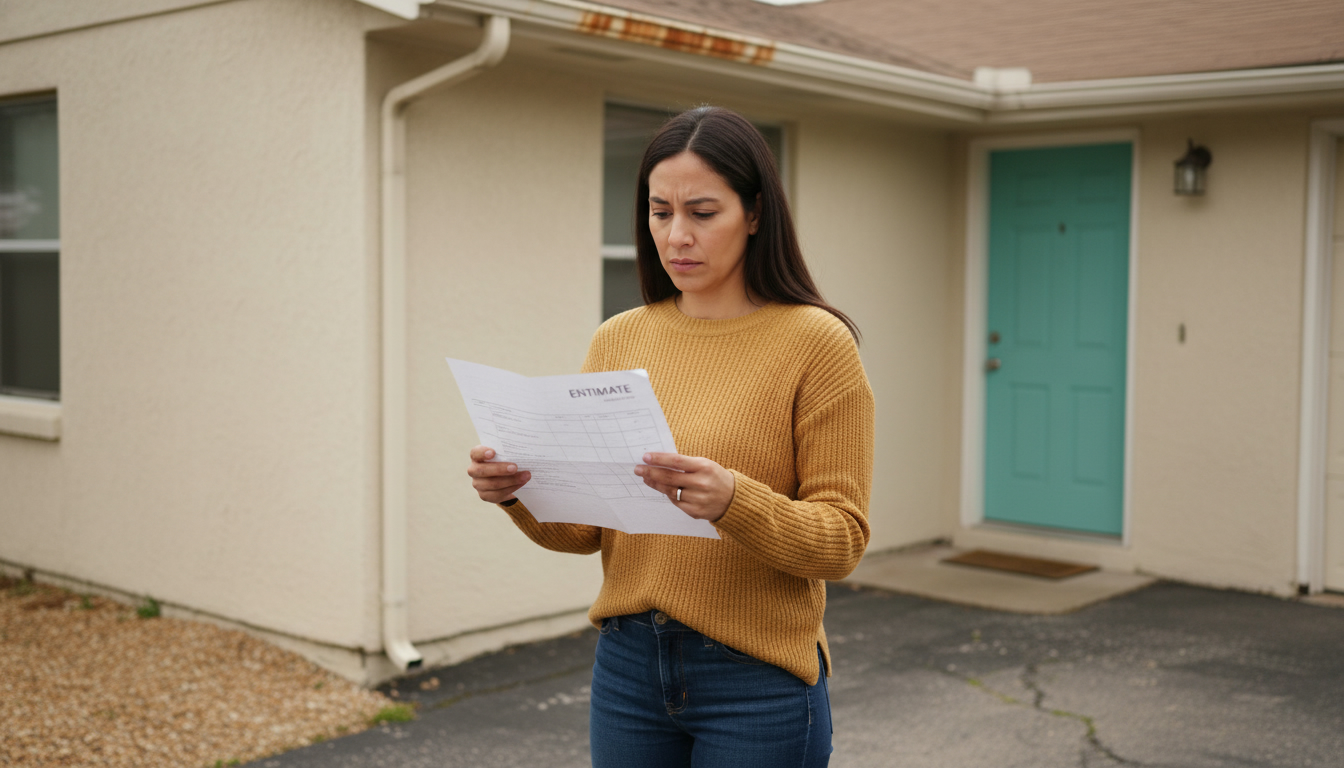
Always get a written estimate with line-item detail: linear footage, material type, gauge, downspout count, fascia repair if applicable, and per-foot labor rate. A quote that reads “160 lf gutters – $840” cannot be compared to anything.
Red flags during the quote process
Legitimate installers measure the job in person. Anyone quoting a firm price over the phone before knowing your fascia condition is not pricing the job correctly.
A quote that arrives the same day the salesperson left – sometimes within an hour – is a pressure tactic designed to close you before you call anyone else. Legitimate estimates take time to calculate.
Watch for proposals that bundle gutter guards into the base price without asking. Guards add $1 to $4 per linear foot and are not right for every property. Automatic bundling is upselling or quote-padding.
Never pay more than 30 to 40 percent upfront. Standard practice is a deposit on signing, balance on completion. Full payment in advance or cash-only demands are warning signs. Finally, match the crew to the scope: a steep roof or multi-story home with a complex hip roofline needs a crew that can describe the access equipment they plan to use – not just a general “we’ve done this before.”
Understanding the cost range
| Scope | Typical Range | Notes |
|---|---|---|
| Standard aluminum, 150 lf, single story | $600 – $1,100 | Sectional; basic downspout placement |
| Seamless aluminum, 150 lf, single story | $750 – $1,400 | On-site roll forming; fewer leak points |
| Standard aluminum, 200 lf, two story | $1,000 – $1,800 | Added ladder/access labor |
| Copper gutters, 150 lf | $3,000 – $5,500 | Premium; 50+ year lifespan; specialty install |
| Fascia board replacement (per linear foot) | $6 – $20 | Only needed if wood is rotted |
| Gutter guard add-on | $1 – $4 per lf | Micro-mesh guards at higher end |
Your estimate may vary based on your region, local labor rates, and the complexity of your roofline. The Southeast typically runs 10 to 15 percent below national average on materials and labor. The Northeast and Pacific Northwest often run 15 to 25 percent above. If a quote lands well outside these ranges in either direction, ask the contractor to walk you through the line items.
Ready to compare local gutter installer quotes? Find a vetted gutter installer near you via Thumbtack and get free quotes from background-checked pros.
FAQ
How long does gutter installation take?
Most full-perimeter replacements on a standard home take four to eight hours for an experienced two-person crew. A one-story ranch is done in a day; two-story or complex rooflines can stretch to two days. More than that without a clear explanation deserves a question.
Should I replace gutters before or after a roof replacement?
After. Roofers often remove or detach gutters during a re-roof, and installing new gutters beforehand means paying for the work twice. Coordinate the contractors so the roofing crew finishes first.
What is the difference between K-style and half-round gutters?
K-style has a flat back and decorative front profile – the dominant style on modern American homes. Half-round gutters are curved tubes common on older homes. K-style holds more water volume, costs less, and installs faster. Most gutter replacements use K-style unless specified otherwise.
Do I need gutter guards?
It depends on tree coverage. Heavy deciduous canopy – oak, maple, sweet gum – makes micro-mesh guards worth the $1 to $4 per linear foot premium. Minimal tree coverage means twice-a-year cleaning is usually cheaper than guards.