Hire a Deck Builder Near You
7 min read · Last updated September 14, 2026
- Wood decking runs $11.51 to $14.79 per square foot installed and composite decking runs $23.50 to $28.75, per Homewyse’s May 2026 cost data, before footings, railings, or stairs are priced separately.
- Any deck surface more than 30 inches above grade needs a guard at least 36 inches tall with no gap wide enough to pass a 4-inch sphere, per the American Wood Council’s residential deck construction guide.
- Footings must sit at least 12 inches below undisturbed ground or below the local frost line, whichever is deeper, and the building official verifies soil conditions before concrete gets poured.
- Lumber prices are up 7.6% year over year and ready-mix concrete is up 2.3%, both through August 2026, so a quote from a year ago is already out of date.
A deck builder quote is really three separate quotes stacked together: material, structure, and permit work, and skipping any one of them is how the same 320-square-foot deck comes back at $9,800 from one contractor and $21,000 from another for what’s supposed to be identical work.
In this article
- What a deck builder does that a general contractor might not
- What to prepare before you contact a deck builder
- How deck quotes break down by material and square footage
- Permit and setback questions to ask before signing
- Red flags and licensing checks that protect your project
- Frequently asked questions
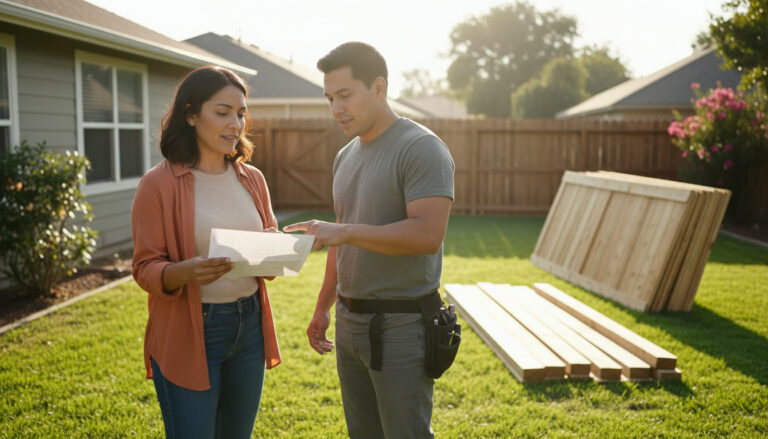
Marcus called three contractors to replace a rotted second-story deck behind his house outside Charlotte. The quotes came back at $9,800, $14,200, and $21,000, all supposedly for the same 320-square-foot footprint. The spread wasn’t the crews’ hourly rates. It was decking material, footing depth, and whether the low bidder had actually priced a permit at all.
What a deck builder does that a general contractor might not
A general contractor can build a deck, but a dedicated deck builder prices and frames decks every week, which shows up in two places: the joist and beam spans, and the footing depth. The American Wood Council’s Prescriptive Residential Wood Deck Construction Guide, the industry reference most local building departments accept for single-level attached decks, sets minimum post sizes, joist spans by species and spacing, and footing depth by a specific rule: footings sit at least 12 inches below undisturbed ground or below the local frost line, whichever is deeper, and a footing closer than 5 feet to the house foundation has to bear at the same elevation as the house footing. A generalist who under-sizes a beam or shortcuts a footing passes inspection less often, and a re-inspection delays the whole project by weeks. Ask any bidder how many decks they’ve framed in the last 12 months, not just remodels in general. If you haven’t already vetted a contractor’s license, our guide to verifying a contractor’s license in under ten minutes walks through the exact steps.
What to prepare before you contact a deck builder
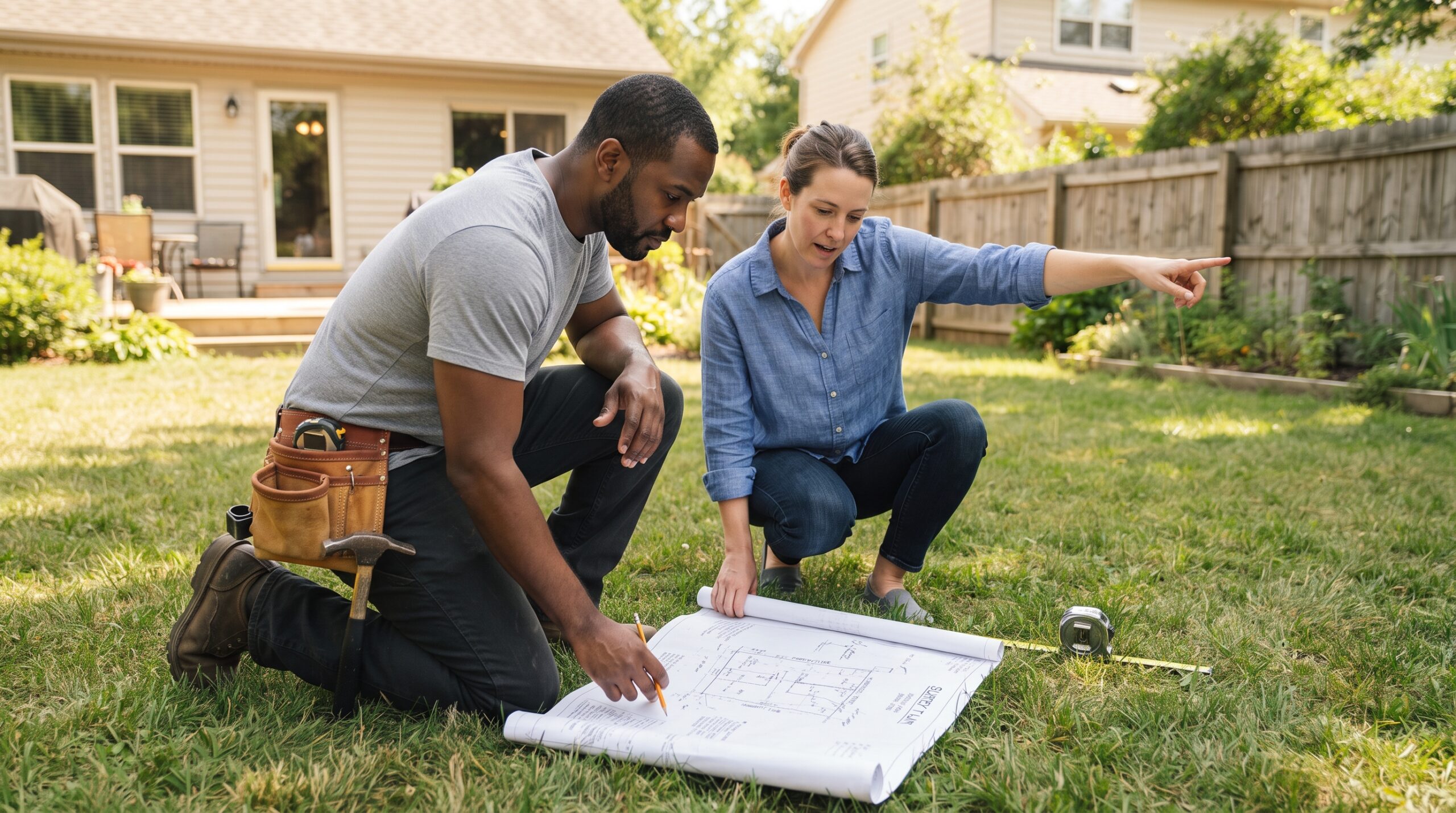
Bring three things to the first call: a property survey (or a copy from your county assessor’s site if you don’t have one on hand), rough measurements of where the deck will attach to the house, and any photos of the ledger-board attachment point, the spot where the deck bolts into the house rim joist. A builder who sees the attachment point in a photo before showing up can quote framing accurately on the first visit instead of padding the number for unknowns. If your property is governed by a homeowners association (HOA), pull the deck-specific rules too. Height limits, material restrictions, and setback minimums are common HOA add-ons on top of whatever the city or county already requires.
How deck quotes break down by material and square footage
Homewyse’s May 2026 national cost data puts wood decking at $11.51 to $14.79 per square foot installed, and composite decking at $23.50 to $28.75, roughly double. For Marcus’s 320-square-foot deck, wood at $13 per square foot runs $4,160 in decking material and labor; the same footprint in composite at $26 per square foot runs $8,320, a $4,160 gap before footings, framing, railings, or stairs are priced as separate line items. Lumber’s own producer price index is up 7.6% year over year through August 2026, and ready-mix concrete used for footings is up 2.3% over the same period, so last year’s ballpark is already stale. For general contractor-vetting steps beyond licensing, see how to hire a contractor without getting burned.
| Decking material | Typical cost per sq ft | Best for |
|---|---|---|
| Pressure-treated wood | $11.51 – $14.79 | Lowest upfront cost, classic look, needs restaining every 2-3 years |
| Composite / synthetic | $23.50 – $28.75 | Low maintenance, consistent color, no annual sealing |
| Aluminum | $24.57 – $30.16 | Fire-resistant, common in wildfire-prone regions and rooftop decks |
Permit and setback questions to ask before signing
Setback distance, how far the deck’s edge must sit from your property line, is set by your local zoning code, not a national standard, and it varies from as little as a few feet to 15 feet or more depending on the municipality and whether the setback is a rear, side, or corner lot line. Ask your builder to confirm the exact setback with your local planning department before any framing starts, not after. Separately, ask whether the project needs a building permit at all; most jurisdictions require one once the deck attaches to the house or the walking surface sits more than a couple of feet above grade, and building without one when one was required can force a teardown later. Two questions the deck guide above makes explicit and worth asking directly: has the crew called 811 to locate utility lines before digging footings, and will any footing land over a septic tank, leach field, or enclosed utility meter? The guide states plainly that footings should never be placed over a septic system, leach field, utility lines, or enclosed meters.
Red flags and licensing checks that protect your project
For a deeper breakdown of what drives the number itself, see our deck construction cost guide. Beyond the number, get at least three quotes before you commit; a single bid gives you no way to tell whether a number is fair. Verify the contractor’s license and insurance before signing anything, ideally by checking your state’s contractor licensing board directly rather than taking a business card’s word for it. Every quote should come as a written estimate with line-item detail, footings, framing, decking, railings, and stairs priced separately, not one lump number. Match the contractor’s recent experience to your project’s scope; a crew that mostly builds ground-level patios may under-price a raised, two-story deck with stair and guard requirements. And remember the lowest bid isn’t automatically the best one: find out what it leaves out (permit fees, haul-away, a warranty on labor) before assuming it’s the same job for less money.
Ready to compare local deck builder quotes? Find a vetted deck builder near you via Thumbtack and get free quotes from background-checked pros.
Frequently asked questions
How much does it cost to hire a deck builder in 2026? Homewyse’s May 2026 data puts wood decking at $11.51 to $14.79 per square foot installed and composite at $23.50 to $28.75. A 320-square-foot deck in wood runs roughly $3,700 to $4,700 in decking alone; the same footprint in composite runs $7,500 to $9,200. Footings, framing, and railings price separately.
Do I need a permit to build a deck? In most municipalities, yes, once the deck attaches to the house or the walking surface sits more than a couple of feet above grade. The exact trigger is set locally, so confirm with your building department before work starts rather than assuming your project is exempt.
How far does a deck have to be from my property line? Setback distance is set by local zoning, not a national code, and can run from a few feet to 15 feet or more depending on your municipality and which lot line the deck faces. Your builder should confirm the exact number with your planning department before framing begins.
Should I hire a deck specialist or a general contractor? A specialist who frames decks weekly is more likely to size joists and footings correctly on the first try, based on the industry’s prescriptive span tables. A general contractor can still do the work well, but ask how many decks they’ve built in the past year before assuming equal experience.
How many quotes should I get before choosing a deck builder? At least three. A single bid gives no basis for comparison, and a wide spread between bids usually means the bidders priced different scopes, not that one is simply cheaper for the same work.