Hire a Tree Service Near You
*5 min read · Last updated June 04, 2026*
In this article
– What to prepare before the estimate – Questions to ask every tree service – Red flags during the quote process – How to read a tree service quote – FAQ
Diane booked a tree removal for the dying elm overhanging her deck in Raleigh. The first company quoted $475 and showed up with two people and a handsaw. The second – ISA-certified, insured for $2 million, chipper truck in the driveway – quoted $840. Three weeks after Diane chose the cheaper option, a limb dropped onto her neighbor’s fence. The crew had disappeared; Diane’s homeowner’s insurance denied the claim because the contractor was uninsured. The fence cost more to repair than the $365 she saved.
What to prepare before the estimate
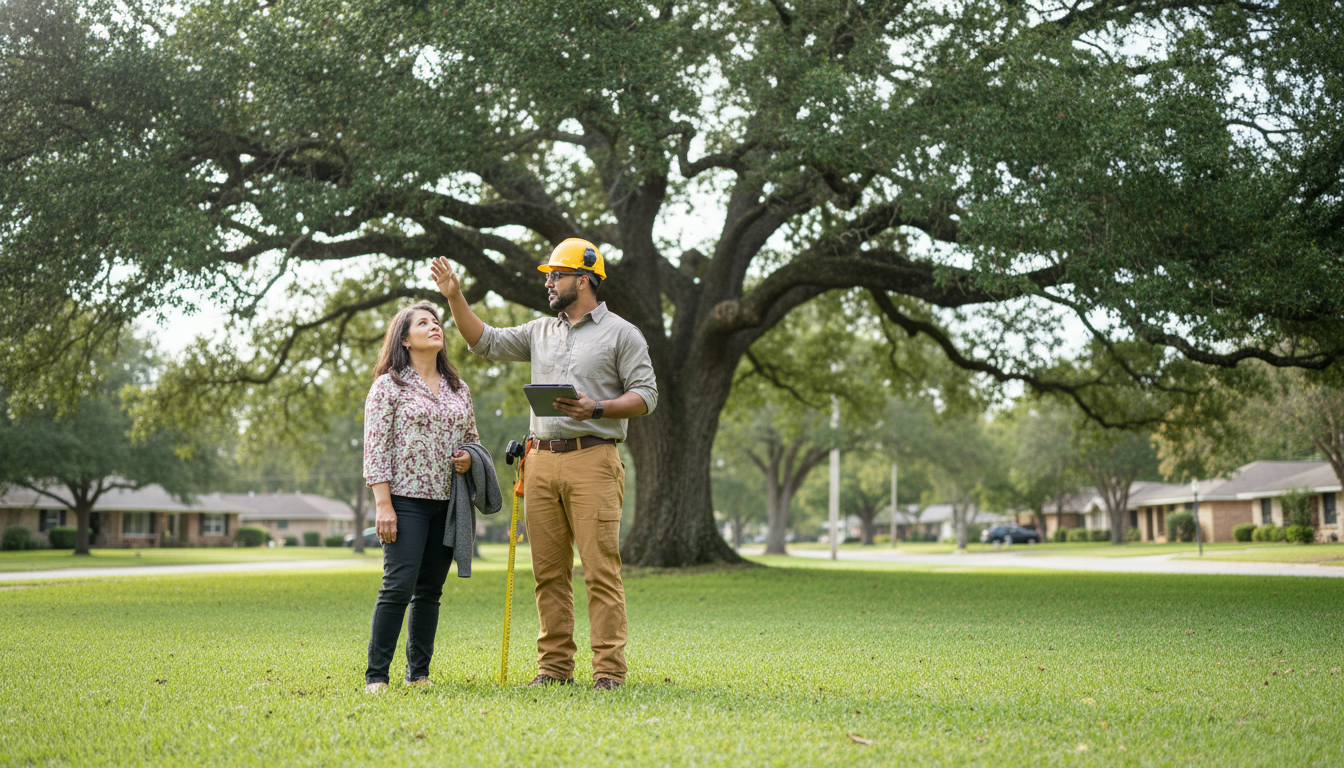
Photograph the trees from multiple angles before calling anyone: base, canopy, and any branches near structures or power lines. Estimate height using your roofline as a reference – one story is roughly 15 feet; a 30-foot tree is double that.
Identify what is in the drop zone: structures, fences, neighboring buildings, power lines. Trees near structures cost more because they require directional cutting. Trees within 10 feet of power lines require utility coordination – not every company is cleared to work that close.
Check your municipality’s tree ordinance before calling. Many cities require a permit for removal above a certain trunk diameter; some have protected species lists. A licensed company will know and include permit costs in the quote.
Finally, look up your state’s licensing requirements. The ISA certification is a voluntary credential indicating real training that you can verify at treesaregood.org – ask for the certification number for jobs over $500.
Questions to ask every tree service
Are you licensed and insured? Minimum $1 million general liability for tree work, plus workers’ compensation for all employees. Request a current certificate before signing.
Do you have an ISA-certified arborist on staff? Ask for the number, verify at isa-arbor.com. Not legally required in most states, but indicates real training. It matters for large trees near structures.
Who is doing the work? Ask directly: employees or subcontractors? If subcontractors, are they covered under the company’s policy?
Does the quote include stump grinding and debris removal? Almost never by default. Stump grinding adds $100 to $400 per stump; debris haul-off adds $50 to $200. Confirm both in writing.
Get a written estimate itemizing each tree, work scope, equipment, crew size, stump disposition, debris removal, and permit costs.
Red flags during the quote process
An unsolicited door knock after a storm from someone claiming to have a truck in the area is a storm chaser – they collect a deposit and disappear. Never sign anything on the spot after a storm.
Omitted line items are the most common way $600 becomes $1,100. A professional estimator tells you what is not included; a problem contractor lets you find out on the invoice.
Never pay in full before the job starts. Standard is 30 to 40 percent deposit on signing, balance on completion. Full upfront payment or cash-only demands are warning signs specific to this trade.
If the crew plans to spike-climb a tree you want to keep alive, that is a disqualifying flag. Spikes damage the cambium layer on live trees. Professional arborists use saddle-and-rope or aerial lifts for trimming; spikes are appropriate only on removal jobs.
Finally, match the equipment to the scope. A 60-foot oak over a garage needs a crane or aerial lift and a ground crew of at least three. A two-person crew with a chainsaw is under-resourced for that job.
How to read a tree service quote

A complete quote itemizes: each tree, work type per tree (full removal, crown reduction, deadwood pruning), equipment, estimated crew hours, stump disposition, debris disposal, permit costs, and warranty terms.
When you have three quotes, normalize them before comparing totals. Add stump grinding and debris estimates to quotes that omit them, then compare the adjusted numbers. A quote including both is legitimately more expensive than one that excludes both – what looks like a $200 gap can disappear once you account for the missing line items.
| Scope | Typical Range | Notes |
|---|---|---|
| Small tree removal (<30 ft) | $300 – $700 | Easy access, no structures nearby |
| Medium tree removal (30-60 ft) | $700 – $1,400 | Price rises with proximity to structures |
| Large tree removal (60-80 ft) | $1,200 – $2,200 | Crane often required near buildings |
| Very large tree (>80 ft) | $2,000 – $4,500+ | Emergency access or crane adds significant cost |
| Tree trimming / pruning | $200 – $900 per tree | Depends on canopy size and height |
| Stump grinding (add-on) | $100 – $400 per stump | Diameter-dependent; usually excluded from removal quotes |
| Emergency (storm) removal | 1.5x-2.5x standard rate | Premium for same-day or after-hours response |
Your estimate may vary based on region and access difficulty. A tree in an open yard costs less than the same tree wedged between a house and a garage. Urban markets with equipment access constraints can run 20 percent above these ranges.
Ready to compare local tree service quotes? Find a vetted tree service near you via Thumbtack and get free quotes from background-checked pros.
FAQ
How do I verify an arborist’s ISA certification?
Go to treesaregood.org and use the “Find an Arborist” tool. Search by name or certification number. Certifications require renewal every three years – an expired credential means training has lapsed. Treat ISA verification the same way you would check a contractor’s license for large or complex jobs.
Should I get three quotes or more for tree removal?
Three quotes is the right floor for anything over $500. For a very large tree near a structure or a multi-tree job, five quotes give you better price anchor. For routine pruning under $300, two quotes from verified companies is sufficient.
What happens if a tree service damages my neighbor’s property?
If the company is licensed and insured, their general liability policy covers third-party property damage – get a claim number and contact their insurer directly. If they are uninsured, your homeowner’s insurance may cover it, but your premiums can increase. This is the core reason to verify insurance before work starts.
Is fall or winter the best time to hire a tree service?
Late fall through early spring is best for trimming and major pruning. Trees are dormant, cuts heal cleanly, and many companies offer off-season pricing. For hazardous or dying trees, schedule removal immediately – a compromised tree does not wait for optimal timing.